



On this page
1. What is your situation?
| What you see | Your situation | Where to go |
|---|---|---|
| Your whole course is sold cheaper on a website, forum or small store | Resale of an infringing copy | Sections 2, 3, 4 and 7 |
| It's offered "free" on a download site, with Mega, Drive or other links | Unauthorized distribution | Sections 3, 4 and 6 |
| It circulates in a Telegram channel or group, or is sold through a bot | Distribution on Telegram | Section 5 |
| A competitor publishes your videos, PDFs or text under their name | Copyright infringement, sometimes unfair competition | Section 8 |
| A competitor teaches the same method in their own words and materials | Not necessarily infringement | Section 8 and FAQ |
| Your name or face is used to sell a course you never made | Impersonation | Guide fake store using my name |
This guide covers what is specific to online courses. For social media and YouTube forms, platform by platform, see our copyright infringement page.
2. Prove the course is yours
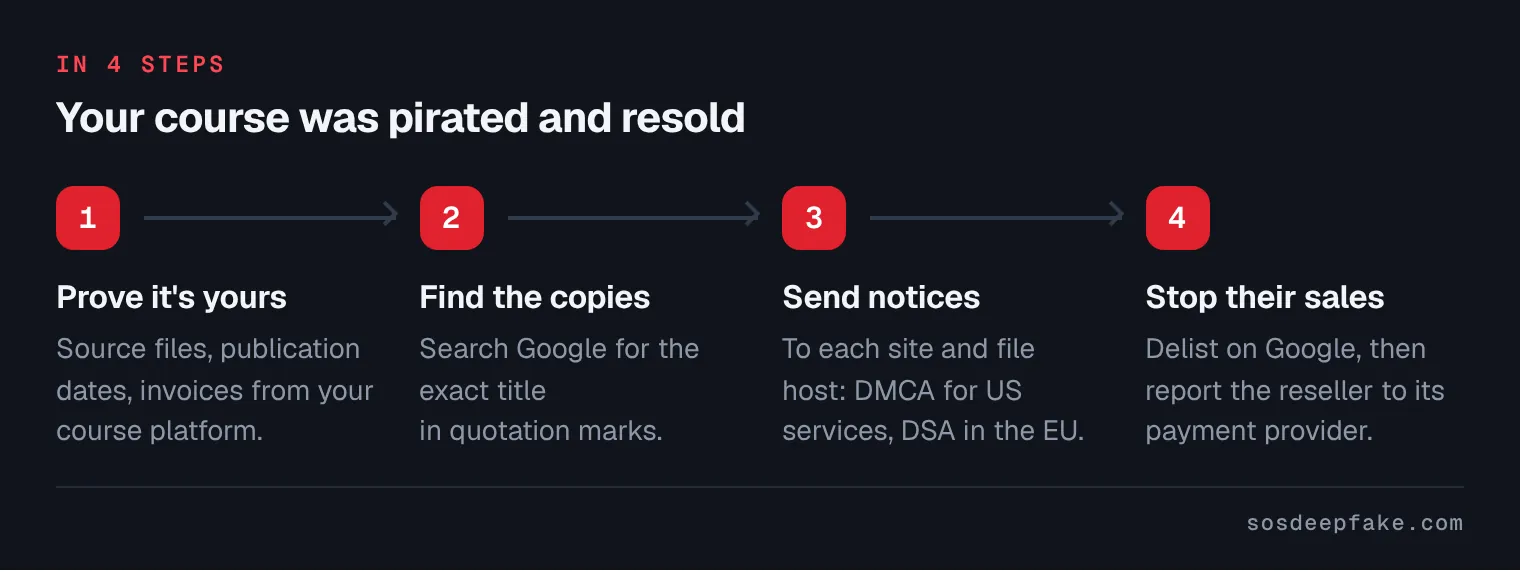
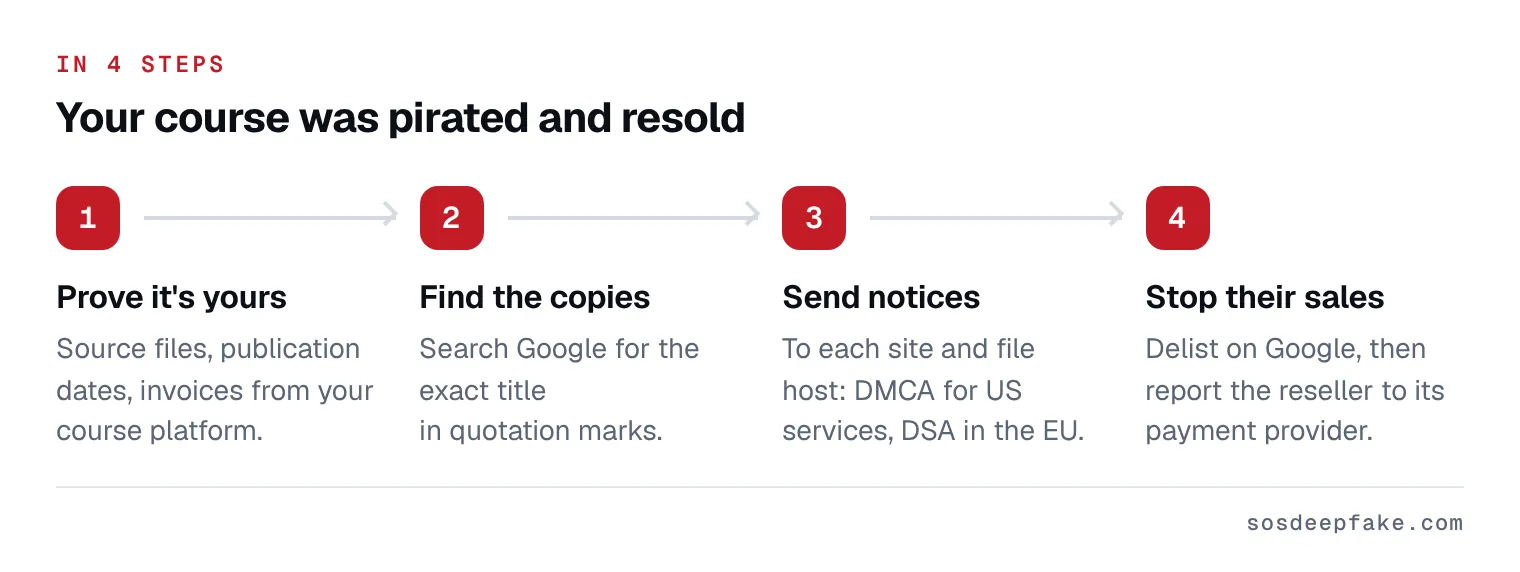
Every notice will ask you to show you are the author. Put this together once, in a folder you reuse for every copy.
- Your source files: raw footage, editing projects, video exports, slide decks and PDFs in their working format. They carry creation and modification dates. Keep them untouched, in two places.
- Your publication dates: when each module went live on your course platform, your sales page, the launch email to your list, announcement posts. A sales page saved in a web archive (for example the Wayback Machine, web.archive.org) also gives a date.
- Your invoices: your course platform subscription, filming, editing or design work, your first customer payments. They date the course and show you produced it.
Then record each copy: exact URL, dated screenshot, asking price, seller name or handle, payment methods shown, number of channel members. Don't download the pirate files: they tell you nothing more and are sometimes booby-trapped. More on method: save evidence before reporting.
3. Find the copies
Google search with the exact title. Quotation marks force an exact match. Combine your course title with the words resellers use:
"Exact course title" telegram"Exact course title" free download"Exact course title" megaordrive"Your name" course free"Exact course title" -site:yoursite.com(the minus sign excludes your own site)
A unique sentence from your materials. Copy a distinctive sentence from your PDF or a video script and search for it in quotes. It's the best way to catch a competitor who copied your text. Add filetype:pdf to search only PDFs.
Reverse image search on your thumbnail. Resellers often reuse your cover image. In Google, use "Search by image" (Google Lens) and upload the thumbnail, or right-click the image in Chrome and choose "Search with Google Lens."
Inside Telegram. The app's search bar usually finds public channels and groups: type the course title and your name.
Your customers. Many leaks are reported by buyers. Give them an email address to tell you, and set a Google Alert on the course title (google.com/alerts).
Log each copy in a simple sheet: URL, date, type (site, file link, channel), who you reported it to, the answer. You'll need it to follow up, and a lawyer will want it if things go further.
4. Get each copy taken down: site, files, host
A "free course" page rarely holds the videos itself: it links to downloads hosted elsewhere. So there are often three parties to contact.
- The site or platform showing the copy. Look in the footer for "DMCA," "Copyright" or "Report illegal content." For social networks and YouTube, the forms are listed on our copyright infringement page.
- The service hosting the files. Report each Mega, Drive or other link to that service, usually through its "copyright" or "takedown" page. Once the link is gone, the download page is useless, even if it stays up.
- The website's host, if the site doesn't respond. Domain registration data (ICANN Lookup, lookup.icann.org) shows the registrar and sometimes the host. If the site uses Cloudflare, use its abuse form (abuse.cloudflare.com): Cloudflare doesn't host the content, but forwards your complaint to the site operator and its hosting provider.
Which kind of notice?
- US service: DMCA notice. US law (17 U.S.C. § 512) requires your signature (a typed name is usually enough in an online form), identification of the work (a link to your sales page), the URL of each copy, your contact details, a good-faith statement, and a statement that the information is accurate, made under penalty of perjury. If a site lists no contact, the US Copyright Office keeps a public directory of agents designated to receive these notices.
- Service established or operating in the EU: Digital Services Act notice. The DSA (article 16) requires hosts to offer a reporting tool and to process notices diligently. A complete notice explains why the content is illegal (here, your course copied without permission), gives the exact URL of each copy, your name and email, and a good-faith statement that the information is accurate.
Our takedown request template gives you the DMCA wording. One notice can list every copy on the same site.
Before you send. Your contact details may be passed on to the person you report, and Google may forward notices it receives to the Lumen project, which publishes them after removing some personal information. Use a business email address. The person can also file a counter-notice, which can lead to the content going back up. Only report your own content: a false statement makes you liable.
5. Telegram: channels, public groups and bots
Telegram says that if a bot, channel or other content on its public platform infringes your copyright, you should send a complaint to dmca@telegram.org, and that requests must come from the copyright owner or an authorized agent.
- Copy the
t.me/…links of the channel, group or bot, and if possible of each message containing your videos or PDFs. - Email dmca@telegram.org: say you are the author, describe the course with a link to your sales page, list the links and include the statements from the DMCA template.
- Also report in the app: the channel and the messages, using the Report button.
- A bot selling your course is reported the same way: it is public content.
Telegram states that private groups and chats are private between their participants and that it does not process any requests about them. For a private group, focus on the public pages sharing its invite link, and talk to a lawyer. More in our guide to removing content from Telegram.
6. Get the copies out of Google
Even if the site won't cooperate, you can ask Google to remove its pages from search results for copyright infringement. Go to Google's "Report content for legal reasons" page, then "Create a request": choose Google Search, then copyright, and list the URLs. A delisted page stays online, but a potential buyer typing your course title no longer finds it. That often protects your sales most. Don't forget other search engines. More: remove a Google result.
7. Cut off the reseller's money
A reseller taking payments depends on their payment provider. Note the payment methods shown on the sales page. A screenshot of the checkout page is usually enough: you don't need to buy the copy.
- PayPal lets intellectual property owners report the use of its services for infringing material, using a form sent to infringementreport@paypal.com. PayPal says it may remove the material from its services or disallow the use of its services.
- Stripe has an intellectual property notice process through a dedicated form. Among other things, Stripe asks for evidence that the seller uses Stripe and that you notified the seller first. Stripe explains that all it can do is continue, or stop, providing payment services: it doesn't take content down.
- Other providers: look for "intellectual property" in their legal pages. If the seller is paid in cryptocurrency, this lever doesn't really exist.
8. A competitor copied your videos or text
Copyright protects the expression: your videos, text, slides, exercises, and the specific way you built and wrote your program. It doesn't protect an idea or a method as such. A competitor teaching the same topic in their own words isn't necessarily infringing. One who reuses your videos, your PDFs or whole passages of your text is.
- Compare: put your dated original and the copy side by side, passage by passage. You'll reuse this for every report.
- Report where the copy is published: social network, YouTube, course platform (most have a copyright procedure in their terms or help center), the host of their website, then Google.
- Send a cease-and-desist letter if you know who it is: describe the copied passages, state your rights and ask for removal by a set date. Stick to facts; a letter from a lawyer often carries more weight.
- If it continues, a lawyer can bring an infringement claim. Depending on the facts and the country, other grounds may apply, such as unfair competition.
9. Make the next leak harder
Nothing stops someone from recording their screen, but you can make leaking harder and riskier.
- A watermark with the buyer's name or email on videos and PDFs: if a copy circulates, you know which account it came from and can close it. Some course platforms include this; otherwise, tools can add it.
- Streaming without downloads, and a limit on devices or simultaneous logins if your platform allows it.
- Your terms of sale: clearly ban sharing and resale, and say what happens if someone shares (access closed). A lawyer can help you word them.
- Your name in the content: logo and name at the start of every video and in the footer of your PDFs. A reseller has to remove them, which takes effort, and they help prove ownership.
- Regular searches with the queries from section 3: the sooner a copy comes down, the less it spreads.
10. What the law says
General information, not legal advice. In most countries, including the US, the UK and EU member states, copyright protects an original work automatically, without registration. In the US, the DMCA notice-and-takedown process (17 U.S.C. § 512) is what most platforms and Google use. In the EU, the Digital Services Act (Regulation (EU) 2022/2065, article 16) sets the rules for notices to hosts, and the Copyright Directive (EU) 2019/790 (article 17) requires large content-sharing platforms to act promptly on a sufficiently substantiated notice. Copyright rules on damages and criminal penalties differ from country to country.
When to see a lawyer? When the competitor or reseller is identified and you want damages; when you're losing significant revenue; when you receive a counter-notice; when a site has ignored your notices for weeks; before sending a cease-and-desist letter to an established business. Look for an intellectual property lawyer.
What we do for you
If copies keep multiplying or come back after each takedown, our leaked content removal service, which covers paid content such as courses, takes over: we search for copies of your course (download sites, forums, public Telegram channels, Google results), send notices in the format each site, file host or search engine requires, and follow up. For copies a competitor posts on social media, see also our copyright infringement service. Coach, trainer or expert, your name is your business: our page for public-facing professionals explains what we do for you. Our team and our AI technology search, document, report and follow up, with formidable efficiency. Every report is checked before it is sent. With the Online Shield, monitoring carries on after the first takedowns. Every day, automated checks. Every week, a full check-up of your online presence. As soon as we find something, we act. Fixed price, refunded if no action is possible: see our pricing page. No result is guaranteed: the final decision belongs to the site, host or platform. For a cease-and-desist letter, a police report or an infringement claim, talk to a lawyer.
If a minor is involved or in danger, see help for under-18s. In an emergency, call 911 (US), 999 (UK and Ireland) or 112.
Checked by Léo, founder of SOS Deepfake.
See pricingFAQ
Is my course protected if I never registered it?
A competitor uses my method in their own words. Can I get it removed?
How long does a takedown take?
Can I find out who leaked my course?
Sources
- Telegram FAQ, "There's illegal content on Telegram. How do I take it down?" (dmca@telegram.org, public content, private groups, Report button)
- 17 U.S.C. § 512 (DMCA), Cornell LII
- Google, "DMCA Policies" (Lumen, counter-notices)
- Google, "Report content for legal reasons"
- Google, "Refine Google searches" (quotes, site:, filetype:)
- Google, "Search with an image on Google"
- Regulation (EU) 2022/2065 (Digital Services Act), art. 16
- Directive (EU) 2019/790 on copyright, art. 17
- Cloudflare, approach to abuse reports
- ICANN Lookup
- PayPal, infringement report policy
- Stripe, "Intellectual Property Notice Process"