



On this page
1. What is happening to you?
| What you see | Your situation | What to do |
|---|---|---|
| A video or ad shows you recommending a remedy, supplement or "cure", often with an AI-altered face or voice | Scam ad, often a deepfake | Sections 2, 3 and 5, and our scam ad guide |
| An Instagram, Facebook or other account uses your name and photo and messages patients | Fake account, impersonation | Sections 2 and 3, fake Instagram account and fake Facebook account |
| A website, account or messaging app offers paid "consultations" or "telehealth appointments" in your name | Fake telehealth, likely fraud | Sections 2, 5 and 7 |
| Patients get calls or voice notes in your voice | Cloned voice | Section 6 and our AI voice clone guide |
| A website sells a product "recommended by Dr…" or "formulated by a pharmacist" | Misleading marketing, sometimes an illegal health product | Section 5 |
| Patients ask you whether it's really you | Answer without breaching confidentiality | Section 6 |
This is a known pattern. In July 2024, The BMJ reported that well-known UK TV doctors were being "deepfaked" in videos promoting products claiming to fix high blood pressure and diabetes. Well-known doctors are the main targets, but a name, a profile photo and a title are enough to build a fake account.
2. First steps, before you report anything
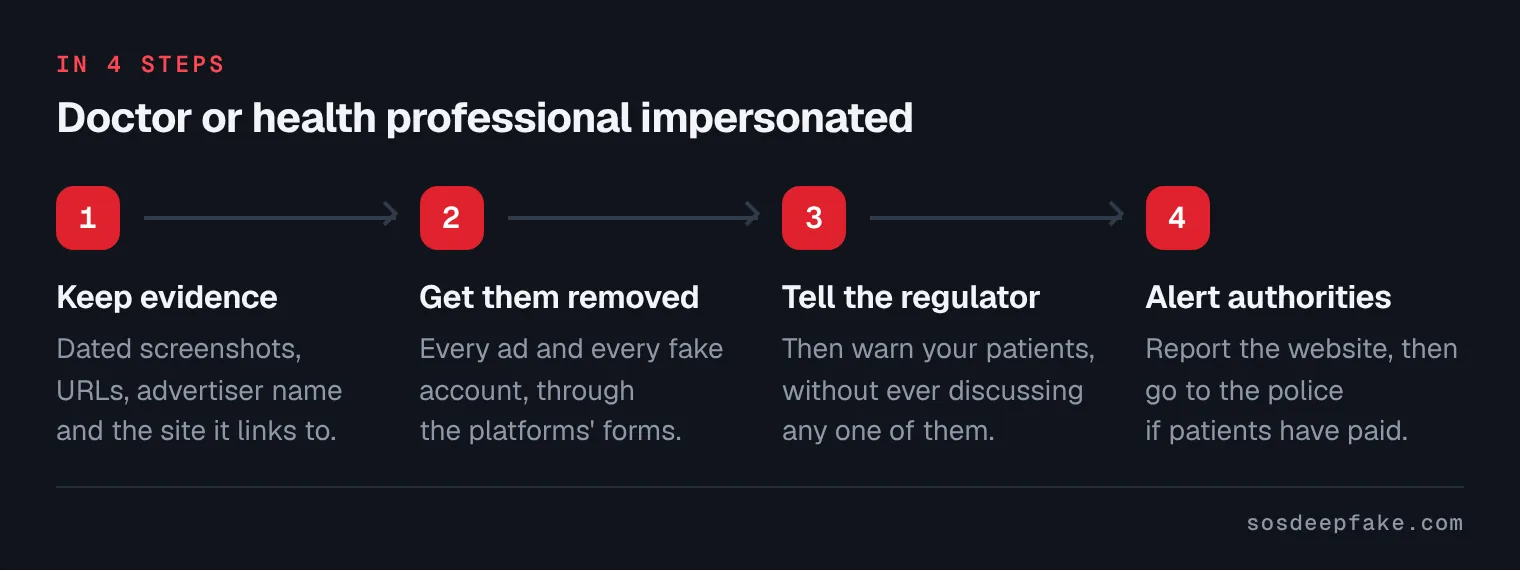
- Take dated screenshots of every ad, account, page and message, and note the exact URL of each. For an ad, also note the advertiser's name and the website it links to. The full method is in our guide to saving evidence before reporting.
- Don't click, don't buy, don't reply to the fake account. Don't comment under the ad: your correction belongs on your own channels (section 6).
- Ask your colleagues and staff (reception, partners, the pharmacy next door) to send you screenshots of what they see, rather than sharing the content.
- Keep messages from patients who alert you in your professional inbox, not in a shared group or on social media: they remain confidential (section 6).
- Keep a log of every step: date, platform, reason selected, reference number, answer. It will help with your regulator, the police and your insurer.
3. Get the ads and fake accounts taken down
The step-by-step for each platform (Facebook, Instagram, Google, YouTube, TikTok, ad libraries) is in our scam ad guide. For accounts, see fake Instagram account, fake Facebook account, fake X account and fake WhatsApp account. What changes when you are a health professional:
- Report each ad separately, as a scam or as impersonation. Google Ads policy bans using a public figure's name, image or voice to imply they endorse a product without their consent, including in AI-generated videos: cite that rule when it applies.
- Say who you are in the free-text field. For example: "I am [profession], [name], registered with [regulator] under number [number]. I have never recommended this product or agreed to this use. This ad uses my name and an AI-altered image of me to present a product I don't know as a treatment. It puts patients' health at risk." A public registration number helps the platform check that you exist.
- Use the impersonation form for the page or account running the ad if it uses your name. On Instagram, that form is reserved for the person being impersonated or their authorized representative, with ID. Send ID only through the official form.
- If a fake website copies your practice or pharmacy name, report it to its host and registrar: see fake website impersonating a business.
- If the platform refuses or doesn't answer: in the EU, file a notice of illegal content under the Digital Services Act (article 16), then use the platform's internal appeal. Our takedown request template gives you the wording.
4. Tell your regulator and give patients a way to check you
Health professionals usually answer to a regulator or professional order. Fake ads are rarely their job to remove, but telling them in writing gives you a dated record and means they know if patients or colleagues ask.
- Write to your regulator or professional body: what is circulating, with screenshots and URLs; the fact that you never agreed and sell nothing; what you have already done; and, if needed, a request for advice.
- Know who regulates you. In the US, doctors are licensed by their state medical board. In the UK, the regulator is the General Medical Council (GMC); in Ireland, the Medical Council. Other health professions have their own regulators.
- Give patients an official way to check you. In the US, your state medical board's website lets the public check a doctor's license. In the UK, the GMC lets anyone search its register to find a doctor and view their registration status. In Ireland, the Medical Council's online register shows whether a doctor is registered to practise. Tell patients that if in doubt, they should call your practice on its usual number, never on a number from an ad.
5. The product, the website or the fake consultation
- Report the website to the authorities: the fraud services listed in step 4 and, if it sells medicines, the medicines regulator (step 2).
- If a medicine is involved (sold without prescription, sold as a "natural" version of a treatment, or counterfeit), say so in every report. In the UK, the MHRA's Yellow Card scheme accepts reports from anyone about an issue with a medicine or medical device, and has accepted reports of suspected counterfeit medicines since 2015.
- Online pharmacies in the EU must display the common EU logo; clicking it should lead to the national list of authorized sellers. If your pharmacy's name is being copied, point patients to that check.
- If patients have paid for a fake consultation or product, tell them to call their bank right away and report the fraud: to the FBI at ic3.gov in the US, to Report Fraud in England, Wales and Northern Ireland (Police Scotland on 101), or to the police where they live. Don't offer to refund them yourself.
6. Warn your patients without breaching confidentiality
A short message to adapt: "Warning: ads and accounts are using my name, my photo and sometimes my voice to sell [a treatment, a supplement, online consultations]. It isn't me. I don't sell any products online and I don't offer consultations through private messages. To book, use only [the practice phone number, your usual booking service]. If in doubt, call the practice."
Where to post it:
- In the waiting room and at reception: a notice, and a line for staff when patients ask.
- On your practice website and professional accounts, pinned.
- On your voicemail greeting, while the ads are circulating.
- On your online booking page, if your booking tool lets you display a notice (check its settings or ask its support).
- To colleagues and pharmacies who refer patients to you.
Confidentiality still applies under a fake ad. Whatever the exact rules in your country:
- Never reply in public about a patient's health or treatment, or even confirm that someone is your patient, including when they comment under the ad or under your warning.
- Use a neutral public reply: "I don't answer personal questions here. For anything about your health, please contact the practice."
- If a patient says they took the product or stopped a treatment because of the ad, see them in a consultation, not through public messages.
- Don't attach any health information to your platform reports, your letter to your regulator or your police report. A patient who was scammed can report it themselves.
If it's your voice. McAfee researchers found that three seconds of audio was enough to produce a clone with an 85% voice match, so a single interview or online video can be enough. Tell staff and patients you never call to sell a product, and see our AI voice clone guide.
7. Reporting it to the police: what the law says
Platform rules ban impersonation and scam ads, so a well-made report often works without going to court. The legal side depends on where you practise. Using a false identity to get money is generally fraud, and some countries also punish online impersonation as such. Bring your screenshots, URLs, log of reports and the copy of your letter to your regulator. If your professional insurance includes legal protection, tell your insurer. Platforms won't tell you who is behind the account: only a legal process can. This page is general information, not legal advice: talk to a lawyer about your own case. More in online impersonation: what to do.
What we do for you
When ads and fake accounts come back faster than you can report them between patients, our fake profile and impersonation removal service takes over. Our page for professionals explains how we work with health professionals, executives and creators. We find the ads from the same scammer and the accounts using your name, report them on the right grounds with dated evidence, and follow up. Our team and our AI technology search, document, report and follow up, with formidable efficiency. Every report is checked before it is sent. After that, the Online Shield stays up: every day, an automated check. Every week, a full check-up of your online presence. The moment we find something, we act. We don't replace your regulator, the police or a lawyer. Don't send us any of your patients' health information: we don't need it. No result is guaranteed, as the final decision belongs to the platform. Fixed price, refunded if no action is possible: see our pricing page. Private content leaking, or a fake account scamming people you know, right now? See our Emergency Response.
If a minor is involved or in danger, see help for under-18s. In an emergency, call 911 (US), 999 (UK and Ireland) or 112.
Checked by Léo, founder of SOS Deepfake.
See pricingFAQ
Can my regulator blame me for a fake ad?
Should I reply to patients who comment on the ad?
The platform is asking for my ID. Is that normal?
I'm a physiotherapist, psychologist or pharmacist. Are the steps the same?
Will the ads come back?
Sources
- BMJ Group, "Trusted TV doctors 'deepfaked' to promote health scams on social media" (July 18, 2024)
- GMC, "The medical register"
- Medical Council (Ireland), "Check the register"
- MHRA, Yellow Card
- MHRA, "Yellow Card extended to include devices, counterfeits and defective medicines" (2015)
- European Commission, "EU logo for online sale of medicines"
- Google Ads policy, unacceptable business practices
- Instagram, impersonation report form
- Regulation (EU) 2022/2065 (Digital Services Act), art. 16
- McAfee, "Artificial Imposters" (voice cloning)
- FBI Internet Crime Complaint Center
- Report Fraud (England, Wales and Northern Ireland)